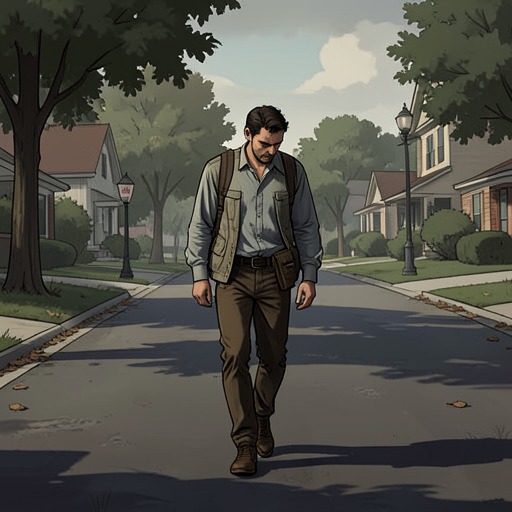
Winston Churchill
The HumansWinston Churchill is a homeless man the narrator follows after seeing Isobel in the rain. Their encounter is brief, but it gives Churchill a history beyond his immediate hardship: he recalls having a house, a car, work, a partner, and a child, and describes the losses that left him with nothing. He is also a person who sets the terms of contact, asks the narrator for money, and questions his decision to give up eternity. The scene turns a chance meeting into a moment of recognition between two people with very different kinds of loss.
Identity and Introduction
Churchill first appears as the homeless man to whom Isobel gives money while walking beneath her umbrella. The narrator, unable to follow Isobel, follows Churchill instead, feeling relieved that she is alive and safe. Churchill’s appearance in the scene is thus connected to the narrator’s longing for Isobel, but he is not merely a route back to her: the conversation soon gives him a distinct voice and account of his life.
Churchill walks slowly, dragging a damaged leg that makes movement visibly difficult. The narrator recognizes the same park where Gulliver walks Newton, but knows it is too early in the afternoon to encounter them there. Churchill eventually reaches a green bench whose flaking paint exposes the wood beneath. The narrator sits beside him, and they share a silence in the rain before Churchill offers him a drink of cider. The setting is ordinary and specific; the bench becomes a place where their conversation can unfold without either man having to explain why he is there.
The Life He Says He Lost
Churchill tells the narrator that he once had a house, a car, a job, a woman, and a child. Asked how he lost them, he describes the betting shop and the off-licence as his two churches, and says that life went downhill from there. The account connects the loss of a whole domestic life with places he names as central to his past, but the scene does not give a fuller chronology or spell out each loss separately. Its blunt inventory is the evidence Churchill offers: former possessions and relationships set against his present homelessness.
He also characterizes his present condition as a kind of honest nothing. The phrase makes no claim that hardship has become comfortable or desirable; it marks the starkness of what remains after the life he describes. When the narrator says he knows how Churchill feels, Churchill responds with doubt. Their circumstances are not shown to be equivalent, and Churchill’s skepticism keeps the exchange from turning into easy mutual understanding.
Boundaries and Exchange
Churchill recognizes the narrator, though the narrator is initially unsure of it. His instruction not to touch his leg again confirms that he remembers earlier contact; the excerpt does not explain when or why it happened. The narrator smiles, acknowledges that Churchill recognized him, and promises not to touch the leg. Churchill’s response makes his boundary explicit, while the narrator’s promise establishes that it will be respected in this encounter. The damaged leg shapes the scene, but Churchill is also shown deciding what others may do in relation to it.
The exchange has practical as well as personal terms. Churchill asks whether the narrator has money, and the narrator gives him a ten-pound note. Churchill thanks him; the narrator answers by suggesting that perhaps they are all stars and looks skyward. The conversation ends when Churchill has finished his cider and has no further reason to remain. He stands and walks away, wincing because of his leg, while the breeze tilts flowers toward him. The narrator does not follow. After Churchill leaves, he stays on the bench, questioning his own sense of lack and need to belong.
Eternity and the Narrator’s Search
Before the conversation ends, Churchill asks why the narrator gave up eternity. The question links the man’s materially reduced life to the narrator’s more abstract renunciation, without making the two experiences interchangeable. The narrator’s answer is not included in this passage; what matters here is that Churchill recognizes a change in him and is willing to ask about it. His directness briefly shifts the scene from the narrator’s observation of other people to a question addressed to the narrator himself.
Churchill’s earlier caution about the narrator’s claim to understand him, followed by this question, gives the encounter its uneven intimacy: recognition is present, but it does not erase difference. The narrator offers money and a promise about the leg; Churchill offers a drink, a fragment of his past, and a question. Neither restores what the other has lost. Yet the meeting leaves the narrator sitting on a rain-soaked bench after the rain has stopped, reluctant to return to Corpus Christi College. Churchill’s departure sharpens, rather than resolves, the narrator’s sense that he needs connection and belonging.